



Florida Amendment 3: What Could It Mean for Brevard County Homeowners?
Potential tax savings could be significant for some homeowners — but so could the impact on local government revenue, fees and services across Florida’s Space Coast.
McCoy Freeman Group at Compass Florida
Florida’s Space Coast Real Estate Market Analyst
Florida voters will decide Amendment 3 this November, a proposed constitutional amendment that could significantly reduce non-school property taxes for many homesteaded homeowners.
For homeowners across Brevard County and Florida’s Space Coast — including Cocoa Beach, Cape Canaveral, Merritt Island, Satellite Beach, Melbourne, Viera, Palm Bay and Titusville — the proposal raises two very different questions:
How much could homeowners save, and what could lower property tax collections mean for the county and cities where they live?
As local governments work through their 2026–27 budgets and Brevard property owners review their annual TRIM notices, we are beginning to get a clearer picture of both sides of that equation.
This article is not an argument for or against Amendment 3. My goal is to explain what we currently know, what remains uncertain and what Brevard County homeowners may want to watch before voting in November.
What Could Amendment 3 Mean for Brevard County?
If Florida voters approve Amendment 3, qualifying homesteaded homeowners could receive a substantially larger exemption from non-school property taxes, potentially lowering their annual property tax bills.
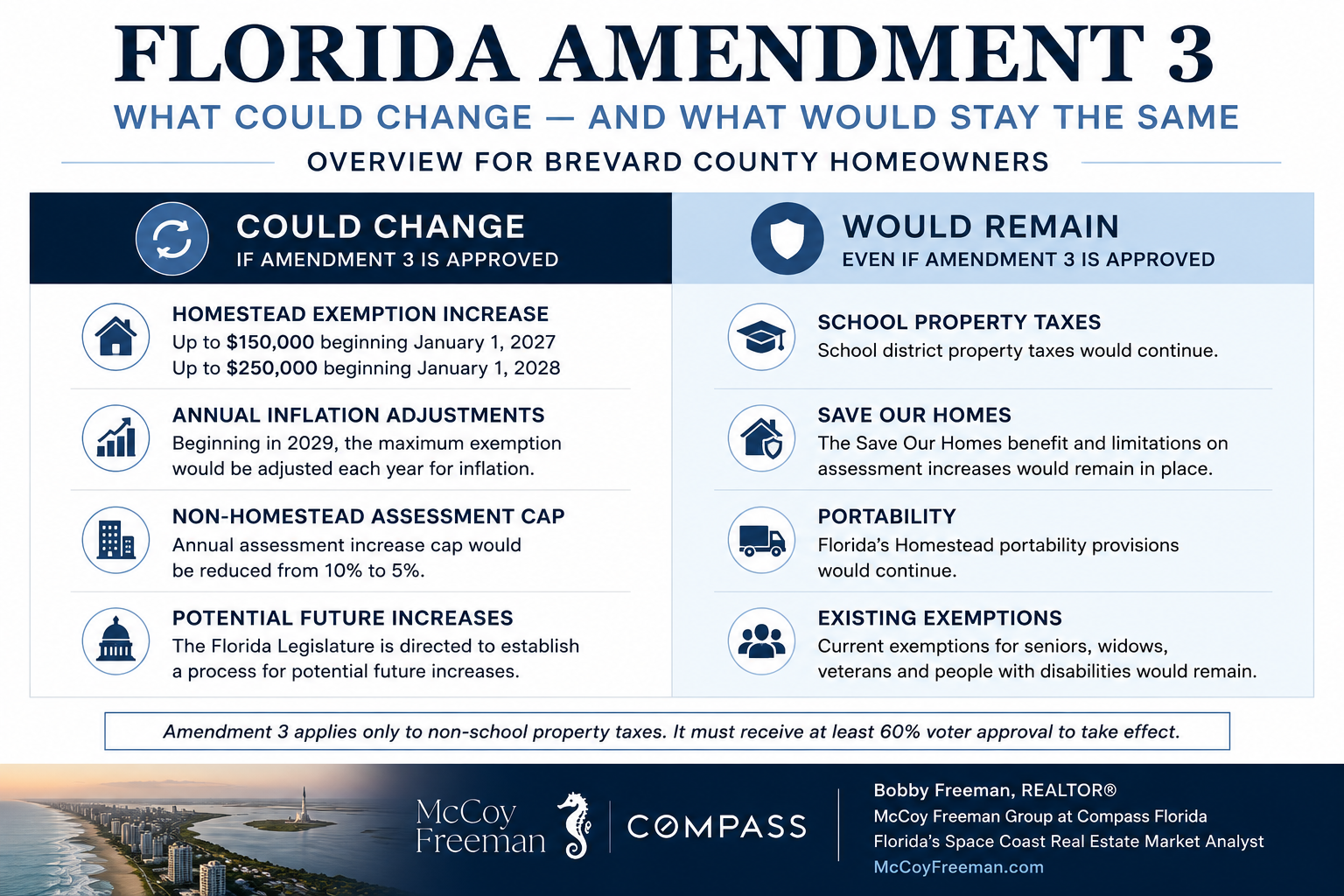
The exemption could increase to as much as $150,000 in 2027 and $250,000 in 2028.
At the same time, Brevard County and local municipalities could collect less property tax revenue from qualifying homesteaded properties. How local governments would respond through budgets, millage rates, fees, assessments or service levels remains uncertain.
What Would Florida Amendment 3 Actually Do?
If approved by at least 60% of Florida voters, Amendment 3 would make several significant changes to Florida’s property tax system.
For qualifying homesteaded primary residences, the exemption from non-school property taxes would increase to as much as:
Beginning in 2029, the maximum exemption would receive annual inflation adjustments.
School district property taxes would continue.
The Brevard County Property Appraiser also notes that the proposal does not necessarily stop at $250,000. The amendment directs the Florida Legislature to establish a process for potential future increases, although the timing and structure of those increases would depend on future legislation.
Amendment 3 would have to receive at least 60% voter approval before these changes could take effect.
A Tax Reduction and an Overall Benefit Aren’t Necessarily the Same Thing
This may be one of the most important distinctions for voters to understand.
A homeowner who qualifies for the expanded Homestead Exemption could receive a direct reduction in property taxes.
But whether that homeowner ultimately experiences an overall financial or quality-of-life benefit is harder to predict because property taxes help fund local government services.
If cities and counties collect substantially less property tax revenue, local governments would still need to determine how to pay for services such as police and law enforcement, fire protection and EMS, roads, parks and recreation, libraries, emergency services and public facilities.
Possible responses could include changes in spending, millage rates, service levels, fees, special assessments or other revenue sources.
That does not mean those changes will happen. It means the homeowner tax reduction is only one part of the equation.
How Much Could a Florida Homeowner Actually Save?
There is no single answer because the amount would depend on the home’s assessed value, existing exemptions, Save Our Homes benefits, county and municipal millage rates, special taxing districts and future local budget decisions.
The Brevard County Property Appraiser has cautioned that an individual homeowner’s exact future savings cannot yet be calculated because future tax rates and implementation details have not been finalized.
Florida TaxWatch has provided a statewide example using an average Florida non-school millage rate. Its analysis estimates that a qualifying homesteaded property with sufficient taxable value could save approximately $1,035 in 2027 and around $2,085 in 2028.
Those figures are statewide examples and should not be considered guaranteed Brevard County savings.
What Could Amendment 3 Mean for Brevard County?
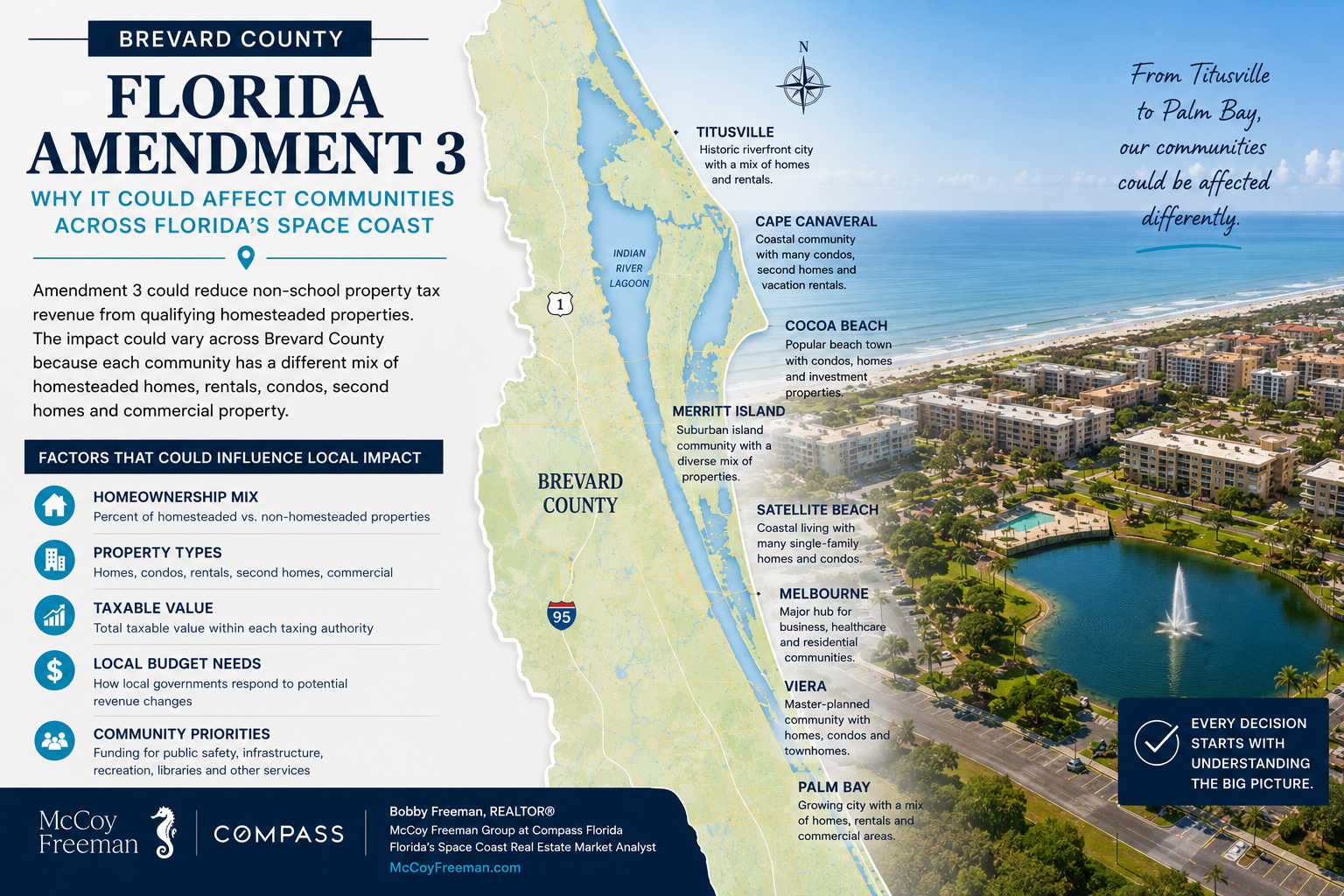
Brevard County is particularly interesting because our real estate market includes a diverse mix of primary residences, oceanfront and riverfront homes, condominiums, vacation properties, second homes, rental properties, commercial real estate and investment properties.
That means Amendment 3 would not affect every Brevard County property owner the same way.
Homesteaded homeowners could potentially receive larger exemptions from non-school property taxes.
At the same time, Brevard County, municipalities and special taxing districts could experience reductions in taxable value and therefore property tax revenue.
How large those reductions would ultimately be depends on future millage rates, taxable values and local government budget decisions.
The potential impact could vary significantly between communities such as Cocoa Beach, Cape Canaveral, Merritt Island, Satellite Beach, Melbourne, Viera, Palm Bay and Titusville because each has a different mix of homesteaded homes, rentals, condominiums, second homes and commercial property.
What About Rentals, Second Homes and Investment Properties?
Amendment 3 is not only a Homestead Exemption proposal.
It would also change the annual assessment limitation for qualifying non-homestead property.
Currently, many non-homestead properties are subject to an annual assessment increase cap of 10%.
Amendment 3 would reduce that cap to 5%.
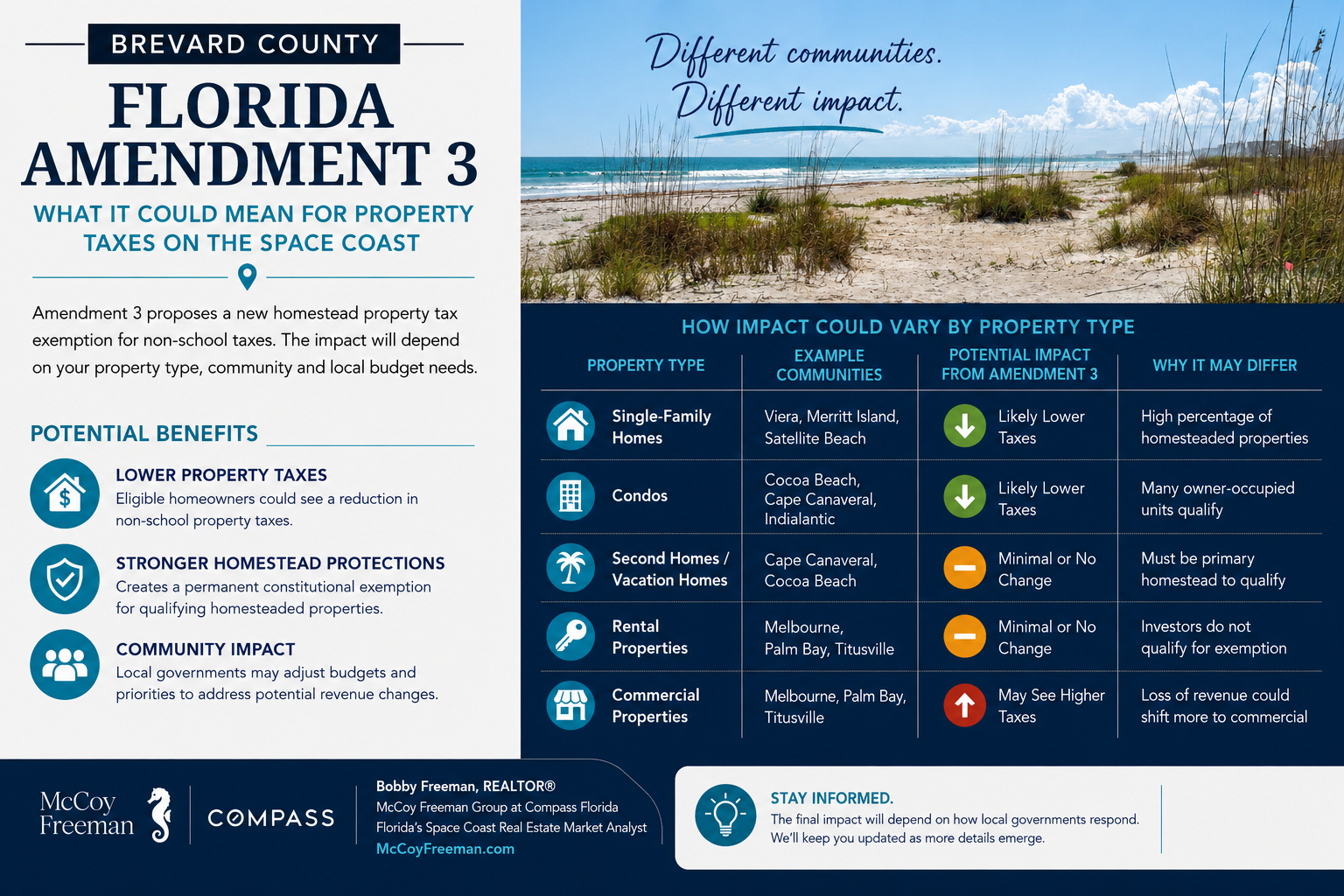
This could affect rental homes, second homes, commercial properties and vacant land by slowing future increases in assessed value for non-school property taxes.
A lower assessment cap does not automatically mean a lower tax bill. The actual amount owed would still depend on taxable value and millage rates established by local taxing authorities.
This provision is especially relevant in coastal Brevard County communities such as Cocoa Beach and Cape Canaveral, where a significant share of the real estate market consists of vacation properties, second homes, rental condominiums and investment real estate.
New Florida Residents Should Pay Attention Too
Another provision could matter to people planning a move to Florida.
Florida residents established by December 31, 2026 could potentially qualify for the new larger exemption beginning in 2027, assuming they otherwise satisfy Florida Homestead requirements.
Residents establishing Florida residency on or after January 1, 2027 would begin under a different structure.
According to the Brevard County Property Appraiser, those new residents would initially receive the exemption available to new Florida residents. After maintaining a qualifying Florida Homestead Exemption for four years, the larger exemption could begin in the fifth year.
For a state — and a Space Coast housing market — that attracts a significant number of relocation buyers, this could become an important financial consideration.
Your Brevard County TRIM Notice Matters
Brevard County property owners should now be receiving their annual Truth in Millage, or TRIM, notices.
The TRIM notice shows your property’s assessed value, taxable value, exemptions, proposed tax rates, estimated property taxes and dates of public budget hearings.
These rates are proposed, not final.
For homeowners trying to understand Amendment 3, the TRIM notice is particularly useful because it identifies the local taxing authorities that currently receive property tax revenue from your home.
Titusville Offers a Useful Local Example
A recent development in Titusville is worth watching — not because Amendment 3 caused it, but because it illustrates an important distinction between property taxes and other local charges.
Titusville approved an FY 2027 stormwater assessment of approximately $181.30 per Equivalent Residential Unit.
That is a non-ad valorem assessment, meaning it is separate from property taxes calculated using a property’s taxable value.
The expanded Homestead Exemption proposed by Amendment 3 would not reduce non-ad valorem assessments.
So even if a homeowner’s ad valorem property taxes decrease, that does not necessarily mean every local charge appearing on a tax bill will decrease.
Brevard County Government Center • Viera, Florida
Why September 8 Matters for Brevard County Homeowners
The Brevard County Board of County Commissioners is scheduled to hold its first September public hearing on the county’s proposed FY 2026–27 budget and ad valorem tax rates on September 8.
The county’s final budget hearing is scheduled for September 22, 2026 at 5:05 p.m.
These hearings are not votes on Amendment 3. Florida voters will decide Amendment 3 in November.
But the hearings offer an important opportunity to understand Brevard County’s current millage rates, revenue requirements, public safety funding, capital needs and spending priorities at the same time voters are considering a constitutional amendment that could significantly change future local property tax collections.
I’ll be watching those discussions closely.
What Amendment 3 Would Not Change
Save Our Homes would remain.
Annual assessment increases on qualifying homestead property would continue to be limited under Florida’s existing Save Our Homes rules.
Portability would remain.
Florida’s existing Homestead portability provisions would continue.
Other qualifying exemptions would remain.
The proposal does not eliminate existing exemptions for qualifying seniors, widows, veterans or people with disabilities.
School property taxes would continue.
The proposed expanded exemption applies to non-school property taxes.
Five Questions Brevard County Homeowners Should Be Asking
That depends on your home’s assessed value, existing exemptions and the tax rates of the local governments and taxing districts where you live.
The impact could vary significantly between Brevard County, individual cities and special taxing districts.
This remains one of the biggest unanswered questions and would ultimately be addressed through future local budgets.
Yes. Amendment 3 would not prevent local governments from changing many fees or non-ad valorem assessments.
Those properties generally would not receive the expanded Homestead Exemption, but the proposed reduction of the non-homestead assessment cap from 10% to 5% could affect how quickly their assessed values increase for certain non-school property taxes.
What I’m Watching Next
Between now and November, I’ll be paying particularly close attention to Brevard County’s September 8 and September 22 budget hearings, guidance from the Brevard County Property Appraiser, municipal budget discussions in Cocoa Beach, Cape Canaveral, Satellite Beach and other Space Coast communities, additional estimates of homeowner savings, changes in millage rates or local fees, and any further state implementation details.
The Bottom Line
Amendment 3 presents Florida voters with a question that is more complicated than simply whether they would like to pay less in property taxes.
Many qualifying homesteaded homeowners could receive meaningful direct tax reductions.
Non-homestead property owners could see slower future growth in assessed values.
At the same time, counties and cities could collect less property tax revenue, leaving local officials to determine how budgets, millage rates, fees and services should adjust.
Some charges — including non-ad valorem assessments — would not be reduced by the expanded Homestead Exemption at all.
For Brevard County homeowners, the picture is becoming clearer, but important questions remain.
That is why September 8 is the next date I’ll be watching closely.
Sources and additional information:
Brevard County Property Appraiser
•
Brevard County Budget Office
•
This article is intended for general informational purposes and is not legal or tax advice.

Bobby Freeman
Bobby Freeman is a REALTOR® and co-founder of the McCoy Freeman Group at Compass Florida, serving buyers and sellers throughout Florida’s Space Coast.
A lifelong Brevard County resident with more than 22 years of real estate experience, Freeman has completed more than 1,500 transactions and over $520 million in closed sales.
He regularly reports on Brevard County housing trends, Florida property taxes, insurance, condominium issues and other topics affecting homeowners across Cocoa Beach, Cape Canaveral, Merritt Island, Satellite Beach, Melbourne, Viera and surrounding Space Coast communities.
Follow Bobby Freeman for Brevard County real estate market reports, homeowner updates and local Space Coast housing news.